
TEXBRASIL: THE MACHINE BEHIND BRAZIL'S FASHION EXPORTS
Every Brazilian label that has shown in Milan, opened a corner at Macy's or landed a rack at Selfridges has, more likely than not, gone through the same 26-year-old program most of the industry has never heard of.
Renata Drews for Gingada · · 7 min read
BFA/Courtesy of PatBO
Every Brazilian label that has shown in Milan, opened a corner at Macy's or landed a rack at Selfridges has, more likely than not, gone through the same 26-year-old program most of the industry has never heard of.
If you've read our features on PatBO or on the ten Brazilian labels that showed in Milan this September, you've already met Texbrasil — you just didn't know its name. It's the quiet infrastructure behind both stories: the reason a brand from Uberlândia ends up on New York Fashion Week's official calendar, and the reason ten women-led Brazilian labels got a self-organized runway slot at Milan Fashion Week instead of a trade-fair stand nobody walked past.
Texbrasil isn't a brand, a showroom or a single event. It's a program — and understanding what it actually is says more about how Brazilian fashion reaches the world than any single runway show can.
WHAT IT ACTUALLY IS
Texbrasil was founded in 2000 by Abit, the Brazilian Textile and Apparel Industry Association, in partnership with ApexBrasil, the Brazilian Trade and Investment Promotion Agency. In plain terms: one side is the industry's own trade body, representing Brazilian textile and apparel manufacturers; the other is a federal agency whose entire job is getting Brazilian goods and services in front of international buyers and investors. Together, they run what Texbrasil calls an "internationalization program" — a two-decade-plus, publicly and industry co-funded effort to help Brazilian fashion companies build a genuine presence abroad, rather than leaving each brand to find its own way into international markets alone.
In practice, that means Texbrasil organizes visits from foreign buyers, press and investors to see Brazil's fashion sector firsthand; runs trade shows, pop-up stores, showroom presentations and runway slots at international fashion weeks; and brokers relationships with the retailers and media that actually move product and coverage — Macy's, Selfridges, Net-a-Porter and Galeries Lafayette among the retail partners it has worked with, alongside press relationships spanning Vogue, Harper's Bazaar and The Guardian.
THE NUMBERS
Over more than 25 years, Texbrasil has supported roughly 2,000 Brazilian brands entering export markets, generating an estimated $11 billion in business, according to reporting on this September's Milan action. That scale is worth sitting with: this isn't a handful of designers getting lucky with a buyer's attention. It's a sustained, funded pipeline that has been running for longer than most of the brands it supports have existed.
Some of that shows up directly in trade figures. Italy alone accounted for 16.9% of Brazilian fashion exports to the EU in 2025 — a market relationship Texbrasil has spent decades cultivating through repeated presence at Milan Fashion Week, long before this year's higher-profile, fully Brazil-organized showcase.
HOW IT ACTUALLY SHOWS UP
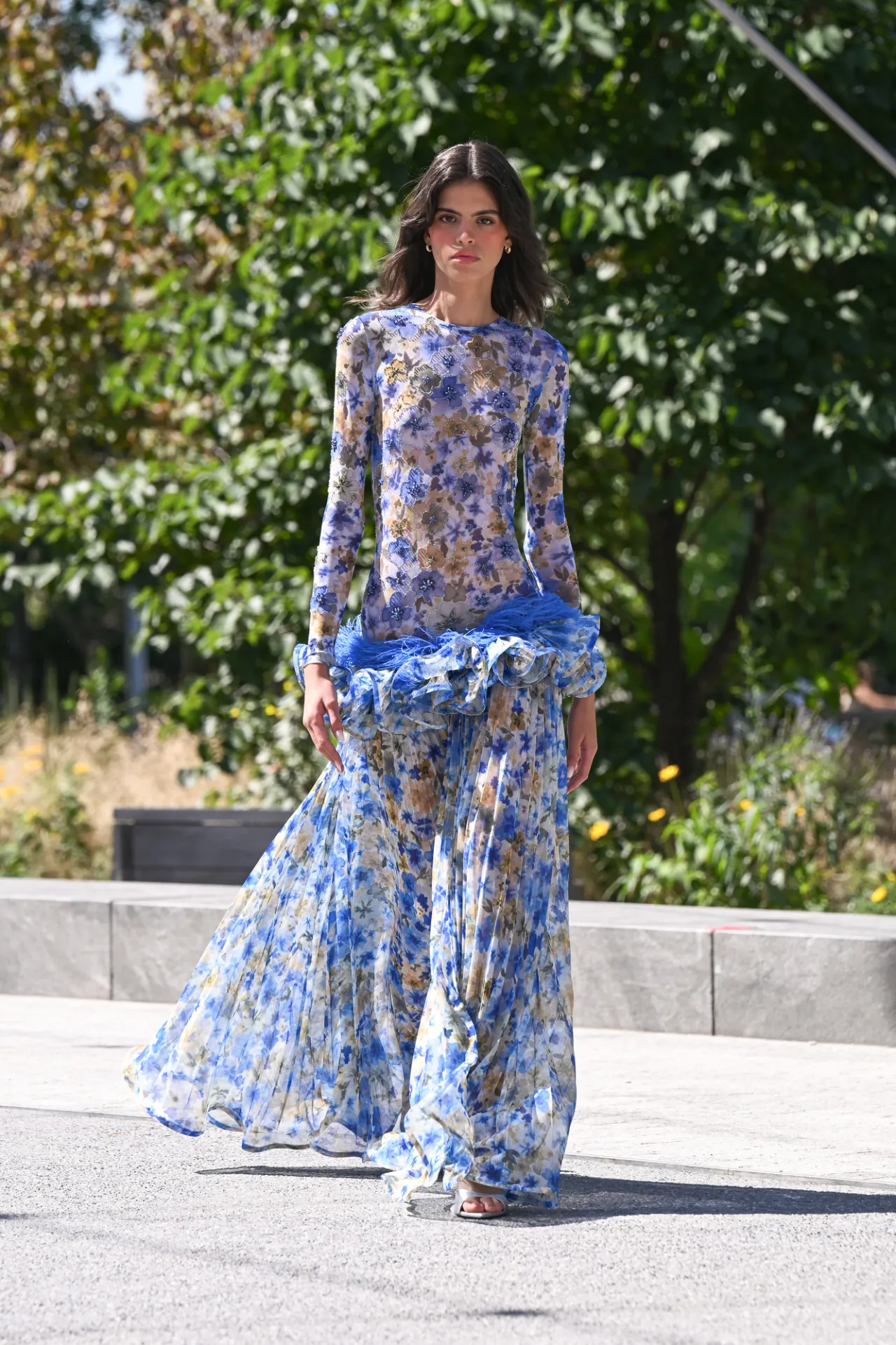
The clearest way to see Texbrasil at work is through a brand you already know from our coverage. PatBO — the label whose hand-embroidered bodysuit Beyoncé wore on the Renaissance tour — is a Texbrasil member, and its rise onto New York Fashion Week's official calendar and into international press coverage has run alongside its participation in the program's export-development work. PatBO's story reads, on its surface, like an accident: a Harrods buyer discovering the brand at a trade show. But that trade show, and the international visibility that followed it, sits inside exactly the kind of infrastructure Texbrasil exists to build.
This September's Milan action is the more visible, more recent example, and it's worth being precise about what was actually Texbrasil and what wasn't. Ten women-led, sustainability-focused labels — Alina Amaral, Ana de Jour, Camila Machado Ateliê, Celeste, Ludimila Heringer, Lybethras, Natural Cotton Color, Proposta Verde, Val Valadares and Villa Dharma — presented a runway show and business showroom through Texbrasil, delivered jointly by Abit, ApexBrasil and Abrimos, the Brazilian Association of Sustainable Fashion, from September 22 to 24. A separate, larger group of 23 Brazilian brands showed at White Milano the same week through Fashion Label Brasil, a different ApexBrasil partnership with the Brazilian Association of Fashion Designers (ABEST) — three brands, Ludimila Heringer, Lybethras and Villa Dharma, appeared in both. Same funding source, same instinct to get Brazil in front of international buyers, two distinct programs. It's a small distinction, but it matters if you're trying to understand how the machinery actually works rather than treating "Brazil showed up in Milan" as one undifferentiated event.
WHY IT MATTERS
It would be easy to read Texbrasil as a bureaucratic footnote — the kind of institutional detail that gets left out of a fashion story because it isn't glamorous. We'd argue it's the opposite: it's the clearest evidence available that Brazilian fashion's presence in Milan, New York and on the floor of Selfridges isn't a series of lucky breaks or a passing trend. It's the product of a specific, named, 26-year-old institution that two national bodies have kept funding and running because it works.
That's a different story than "Brazil is exotic and popular right now." It's a story about infrastructure — the unglamorous, unphotogenic machinery that decides which brands actually get a shot at the rooms that matter, and keeps giving them repeat shots, year after year. If the long-term goal is for the global industry to see Brazilian fashion as a specialist, high-value ecosystem rather than a commodity supplier or a seasonal curiosity, Texbrasil is a big part of the argument — it's the proof that Brazil has been building that ecosystem on purpose, for a quarter of a century, whether or not the rest of the industry noticed.
Sources & further reading
- Texbrasil, "About Us"
- Texbrasil, "ApexBrasil"
- FashionUnited, "Brazilian brands to feature at Milan Fashion Week"
- Texbrasil, "PatBo" company profile
- Texbrasil, "PatBO apresenta coleção na semana de moda de Nova York com experiência imersiva"
Related on Gingada
Keep reading
Business · 23 September 2026
THE PRACTICAL GUIDE: HOW TO PARTNER WITH BRAZILIAN FASHION AND BEAUTY BRANDS
Whether you're a buyer scouting new suppliers, a brand scouting a collaborator, or a Brazilian label scouting your own way into the UK and Europe — here's the actual infrastructure that makes it happen: who runs it, what it does, and where you'll find it in person.
Business · 23 September 2026
WHY GLOBAL FASHION AND BEAUTY BRANDS SHOULD BE CALLING BRAZIL
Every brand looking for its next growth market is running the same checklist: which country is culturally ascendant, and which country's consumers will actually stay once the launch campaign ends? Right now, both answers point to the same place.
Opinion · 24 September 2026
THE EIGHTH ART: WHY BRAZILIAN FASHION DESERVES TO BE STATE POLICY
Brazil grows the world's most exported cotton and spins the silk Hermès depends on, yet its fashion is still treated as commerce alone. The newly founded Brazilian Fashion Council wants to change that.