
THE COLLAB CODE: HOW MELISSA, HAVAIANAS AND FARM RIO PARTNERED THEIR WAY ONTO THE GLOBAL STAGE
In September 2026, Havaianas dropped a football-art capsule with Brooklyn's KidSuper. A few months earlier, Melissa launched jelly heels with Copenhagen's Ganni. Neither is a lucky break — it's the latest chapter in a strategy three Brazilian brands have been running since before "collab" was even a marketing word. Here's the playbook, brand by brand.
Renata Drews for Gingada · · 8 min read
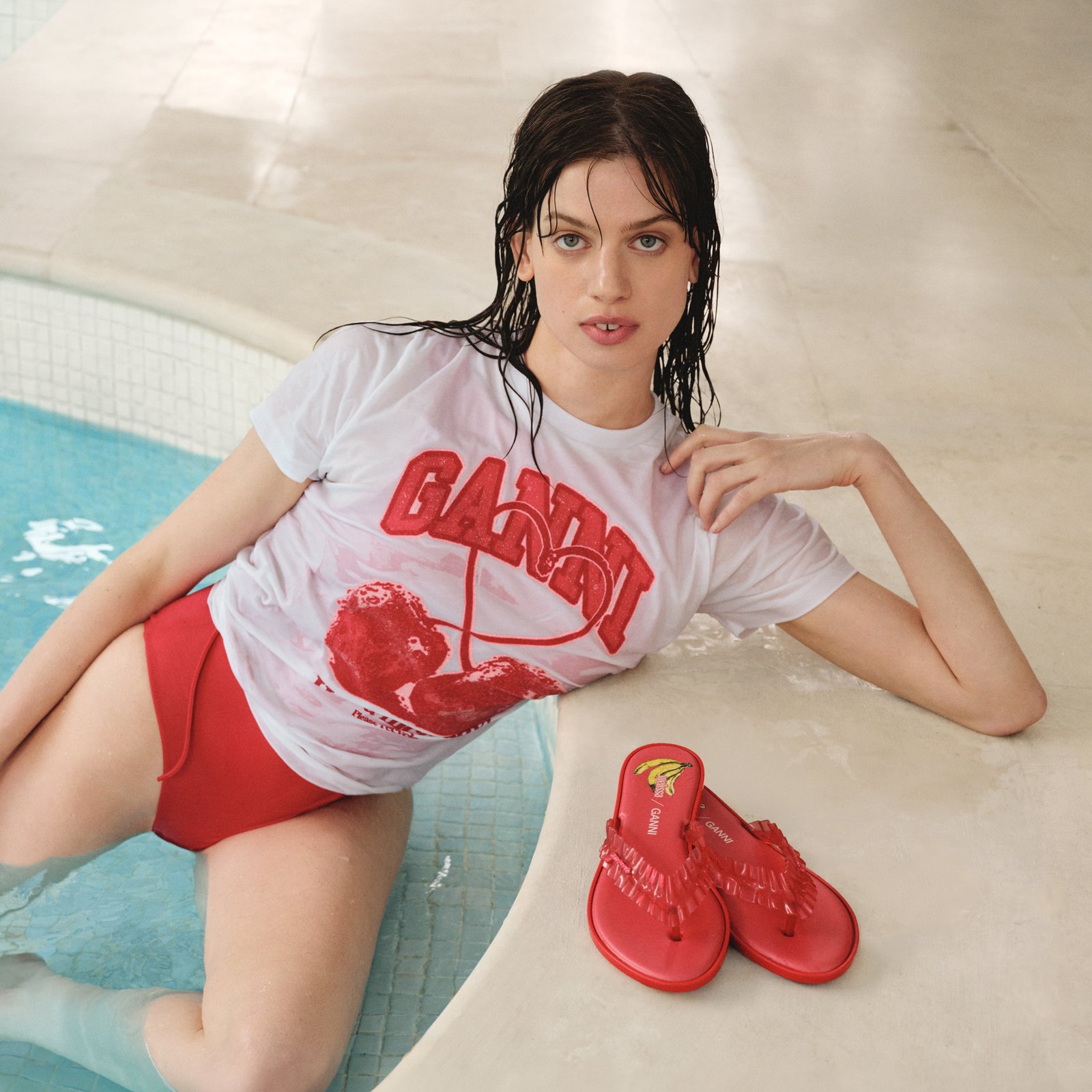
Melissa + GANNI campaign, 2026. Courtesy of Melissa
Zoom out far enough and a pattern appears that's easy to miss when you're only looking at this week's drop. Melissa's newest capsule with Ganni, released in May 2026, is a shoe with kitten heels and leopard print built around a jelly sandal invented in a Brazilian factory in 1979. Havaianas' newest capsule, launched globally on September 8, 2026, is a flip-flop covered in green velvet, designed by a Brooklyn artist who once played semi-professional football in Bahia. Farm Rio's most recent output is a decade-old, ongoing relationship with Adidas that's now old enough to have its own anniversary campaign. None of these are one-off marketing stunts chasing a viral moment. They're instalments in relationships some of these brands have been building for over forty years — proof that the most consistent growth strategy in Brazilian fashion's export history isn't a factory, a campaign or a single design. It's the handshake.
That matters for how the rest of the world reads "Brazilian fashion." A collaboration with Jean Paul Gaultier, Adidas or Ganni isn't the industry borrowing Brazil's colour for a season — it's Brazil's own brands choosing exactly who gets to stand next to them, and being chosen back, again and again, for decades. That's a different story than exotic, seasonal, or Rio-only. It's a track record.
Melissa: the original collaborator
Melissa didn't wait to be discovered. It went looking for the room.
The Brazilian brand launched its first plastic "jelly" sandal in 1979, built on injection-moulded PVC technology nobody else was using for fashion. Four years later — while Melissa was still a young, regional brand with no claim on global attention — its founders reached out to a rising Parisian designer named Jean Paul Gaultier for a shoe. That 1983 sneaker, with cutout panels on the sides and toecap, is now widely cited in trade press as one of the forerunners of the entire designer-brand collaboration model: the idea that a mass-market product and a couture name could make something together that belonged to neither one alone. It predates streetwear's collab boom by more than two decades.
Gaultier and Melissa have returned to the drawing board four more times since — in 1986, 2009, 2010 and again for a 40th-anniversary capsule in 2023, bringing their combined output to seven co-branded styles across forty years. But Gaultier was only the opening move. Over the decades that followed, Melissa built out one of the longest and most eclectic designer rosters in footwear: Vivienne Westwood (since 2008), Karl Lagerfeld, Thierry Mugler, Zaha Hadid, Jeremy Scott, Comme des Garçons, Jason Wu, Viktor & Rolf, Y/Project, Marc Jacobs, Telfar, Diesel — and, as of May 2026, Ganni, whose kitten-heeled thongs and ruffled flip-flops in red, cobalt and leopard print were, per Melissa's own creative director Paulo Pedó, built to capture "a very distinctive point of view on dressing" that mirrors Melissa's own irreverence back at it.
What's easy to miss in that list is the order of operations. Melissa didn't collaborate its way to relevance after becoming famous — it used collaboration as the mechanism to become taken seriously in the first place, while the brand itself was still small. That's the part worth sitting with: forty-plus years before "collab drop" was a retail calendar fixture, a Brazilian footwear brand had already figured out that partnering up, early and often, was how you got a seat nobody was going to hand you.
Havaianas: from work boot to runway, in one show
Havaianas spent its first four decades being exactly what it was built to be: an inexpensive, ubiquitous rubber sandal, patented in 1962 and modelled on the Japanese zori. It wasn't chasing fashion credibility. Then, in 1999, it made a single runway appearance in a Jean Paul Gaultier show — and the brand's own account of its history treats that moment as the hinge point where everything changed. "Havaianas transcends into the world of fashion after making a runway debut in French designer Jean Paul Gaultier's show," the brand's own history reads. "Soon after, havaianas began collaborating with some of the biggest names in fashion and design."
What followed reads like an index of the industry itself: Saint Laurent, Valentino, Manolo Blahnik, Dolce & Gabbana, Simone Rocha, Maison Kitsuné, A Bathing Ape, Christopher Kane's More Joy, Dion Lee, plus cultural crossovers with Disney and Marvel, Stranger Things, and — for its first celebrity-led capsule — Brazilian actress Barbie Ferreira. In 2025 the brand named Gigi Hadid its first-ever global ambassador; in 2026, Brazilian footballer Vinícius Júnior joined her.
Then, on September 8, 2026, came the collaboration that best demonstrates how far the model has evolved: a four-piece capsule with Brooklyn's KidSuper, built around a single sandal — the Top Turf Pitch — with an upper entirely covered in green velvet, designed to feel like the grass of a football pitch underfoot. It was first shown on the runway at KidSuper's Paris Fashion Week show; the full launch was preceded not by a product shoot but by founder Colm Dillane travelling to São Paulo to repaint a public football court with original artwork, turning the neighbourhood pitch itself into the campaign set. Dillane, a former player with a personal history at Bahia's Esporte Clube Vitória, described the goal plainly: "We took this shared love of football and brought it into the KidSuper world through colour, art, and a little bit of the unexpected. The result feels like both brands."
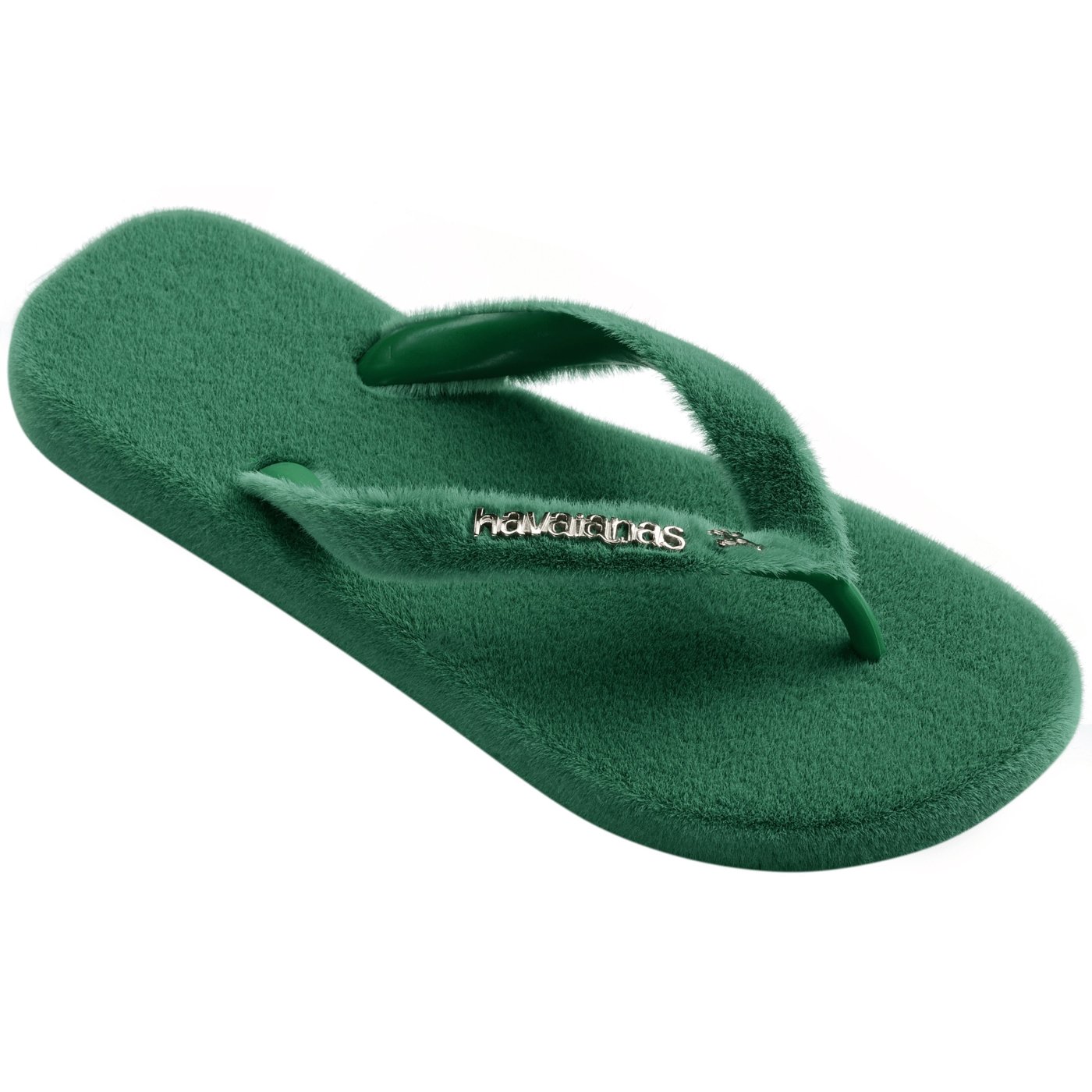
That's the throughline worth naming: Havaianas' collaborations don't dress the brand up as something it isn't. They let outside creative voices — a French couturier, a Brooklyn artist, a Beverly Hills supermodel — translate the same object, the same 1962 rubber sandal, into whatever cultural register they're fluent in. The shoe never changes shape. The story around it keeps expanding.
Farm Rio: collaboration as daily life, not just the runway
Farm Rio's version of the playbook looks different by design, because the brand itself started differently — not as a factory innovation like Melissa or Havaianas, but as a market stall. Kátia Barros and Marcello Bastos began selling their prints from a booth at an independent Rio de Janeiro market in 1997; the brand took its name from Farme de Amoedo, the Ipanema street known for its Carnival energy. By 2019, with more than 100 stores across Brazil, Farm Rio opened its first international flagship in SoHo, New York, and began the expansion that now puts its tropical prints in over 50 countries, from Liberty London and Le Bon Marché to Saks Fifth Avenue and Galeries Lafayette.
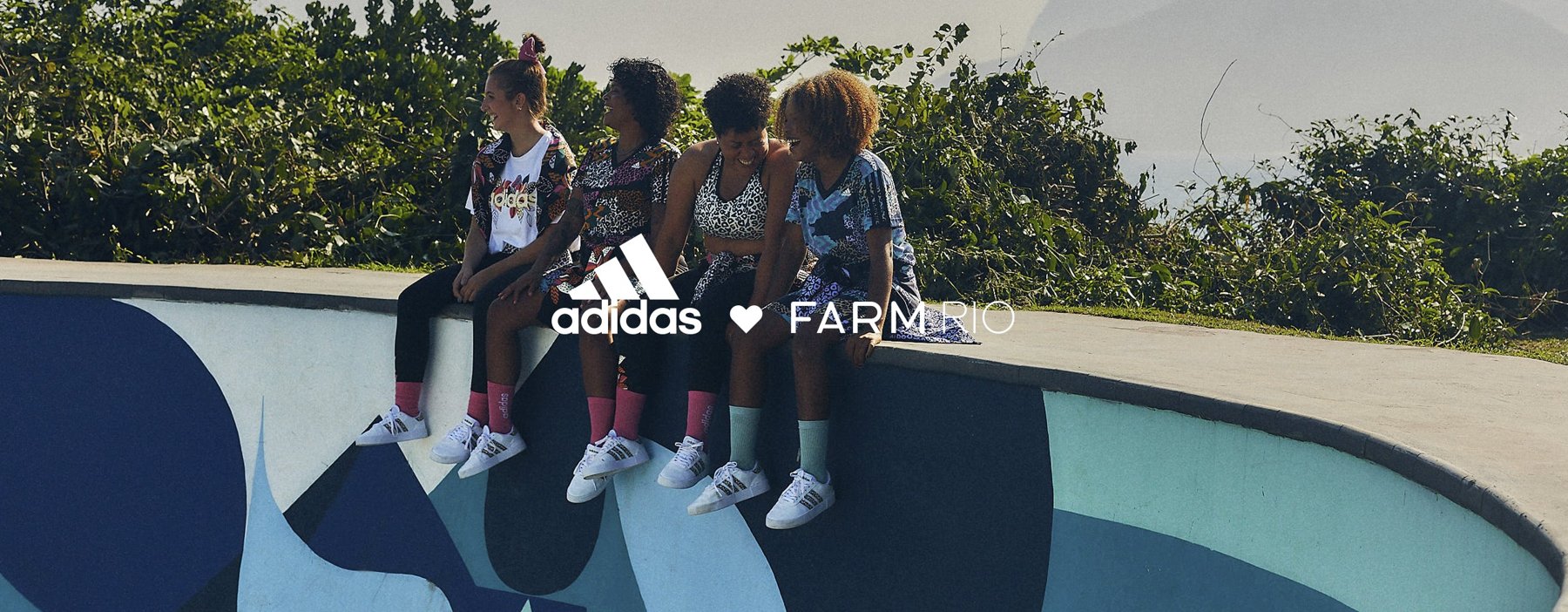
Where Farm Rio's collaboration strategy diverges from its footwear peers is in whom it chooses to partner with. Instead of building its name through couture and high-fashion collaborators, Farm Rio has spent a decade embedding itself into the everyday categories its audience already lives in: sportswear, coffee, pop culture, outerwear, even pet care. The Adidas partnership, running continuously since 2014 and now well past its tenth-anniversary capsule, is one of the sportswear brand's longest-running collaborations of any kind — sitting, per Farm Rio's own head designer Daniela Moritz, on "a true fusion of creative forces," with adidas contributing "urban dynamism and innovative fabric technology" against Farm Rio's "vibrant colors and lush tropical prints." Alongside it: a recurring Starbucks drinkware collaboration now sold across the US, Canada, Brazil and Latin America; a global collection with Smiley marking the icon's 50th anniversary; Barbour's British countryside outerwear reworked in Farm Rio's prints; and even Zee.Dog for pet accessories.
It's a fundamentally different theory of growth than Melissa or Havaianas' designer-forward roster, and it's worth naming as its own valid model rather than a lesser one: instead of asking the global fashion establishment to validate Brazilian design through couture proximity, Farm Rio has quietly made its Brazilian prints a fixture of ordinary mornings — a coffee cup, a hoodie, a dog leash — in more than fifty countries. That's not a smaller ambition. It's a different, arguably harder one: normalisation instead of elevation.
Why this is the strategy, not a side effect
Put the three brands next to each other and the shared logic gets easy to see. None of them treated collaboration as a late-stage marketing tactic, bolted on once the brand was already big enough to matter. Melissa partnered with Gaultier when it was four years old. Havaianas found its opening the moment it stepped, uninvited, into the mainstream fashion conversation, onto a runway. Farm Rio built its global footprint one category-crossing partnership at a time, starting more than a decade before most of its current international stores existed. In every case, the collaboration came first — the global recognition followed.
That ordering matters for how the industry currently talks about Brazilian fashion, and it's a live conversation right now, not a historical footnote. Brazil exported 17.4 million pairs of shoes to Europe in 2025 alone, into a market that accounts for 40% of the world's shoe imports — and under the EU–Mercosur trade agreement now moving through provisional application, the tariffs on that trade are scheduled to phase toward zero over the coming decade. The infrastructure for Brazilian footwear to compete on price is already being built at a policy level. What Melissa and Havaianas' collaboration histories show is that the infrastructure for Brazilian footwear to compete on prestige has been under construction for over forty years, one signed partnership at a time — long before any trade deal made the shipping cheaper.
That's the reframe Gingada exists to make visible: Brazilian fashion isn't waiting for the world's biggest names to notice it. It's been in the room with them since 1983, asking to build something together — and increasingly, it's the world's biggest names asking first.
Keep reading
Business · 23 September 2026
PATBO: MEET THE BRAND THAT DRESSED BEYONCÉ
A workshop of Brazilian artisans in Uberlândia, Minas Gerais, spent 60 days hand-embroidering a bodysuit for the biggest stage on Earth. Here's how the label behind it, PatBO, went from a Harrods buyer's lucky find to the only Brazilian name on the official New York Fashion Week calendar — and where to shop it, wherever you are.
Culture · 24 September 2026
20 BRAZILIAN ICONS YOU NEED TO KNOW: BEYOND THE BRAZILCORE CLICHÉ
Forget the football shirt, Havaianas, and Rio de Janeiro. Here are 20 icons, objects, rituals, rebels and references that Brazilians live with, and that any brand hoping to sell to them, make with them or be inspired by them should know first.
Runway · 15 September 2026
BRASIL ESPLÊNDIDO: INSIDE PATBO'S SPRING 2027 SHOW AT NEW YORK FASHION WEEK
On September 15, 2026, Patrícia Bonaldi closed New York Fashion Week's Spring/Summer 2027 calendar at Domino Square, Brooklyn, with a collection built around the gardens of Roberto Burle Marx — and the brand's first-ever eyewear line. Here's what showed, what it means for PatBO's next category, and how it landed with critics.